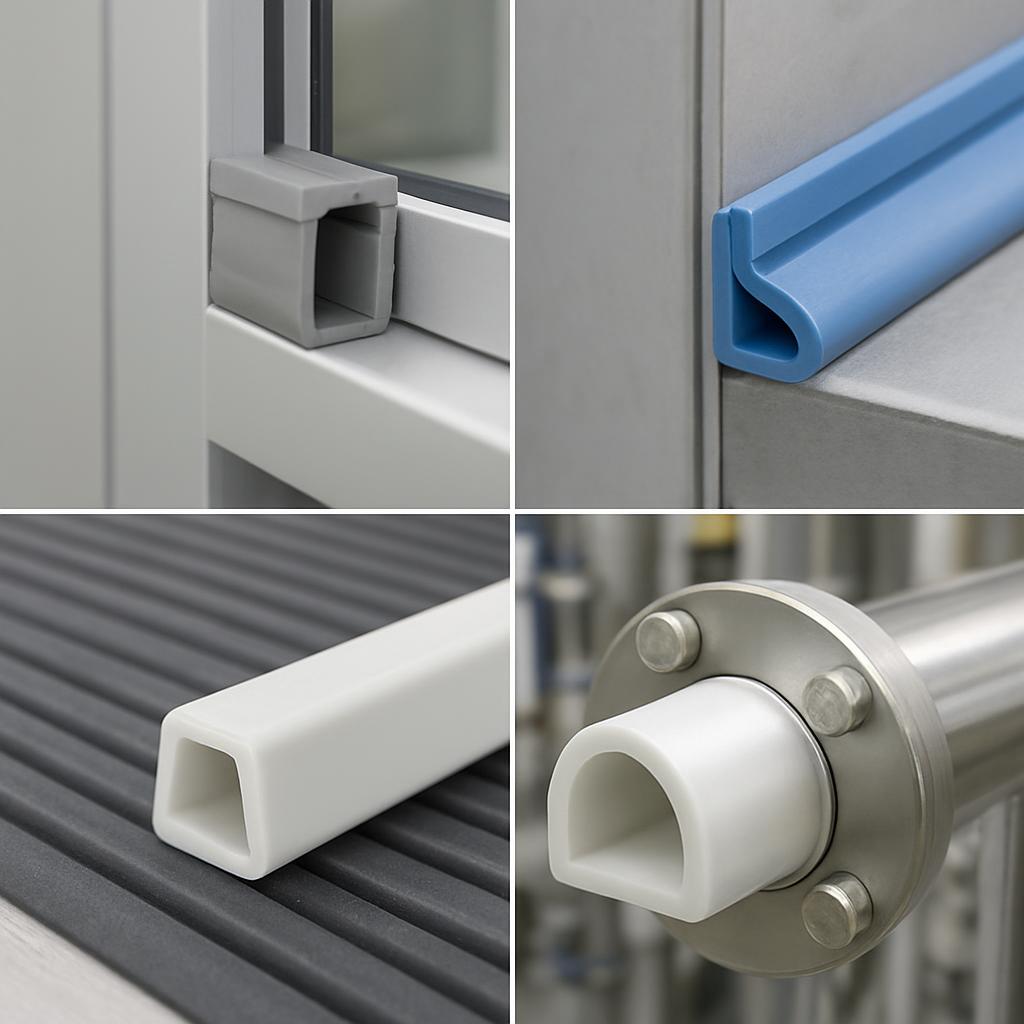
How to select the right silicone profile for your specific industrial application?
Selecting the right silicone profile for industrial applications involves understanding material properties, compliance with standards, and suitable manufacturing methods. Key factors include hardness, temperature resistance, and chemical compatibility, which ensure optimal performance and durability in specific environments.
How does hardness affect the selection of silicone profiles?
The hardness of a silicone profile, measured on the Shore A scale, plays a crucial role in its application suitability. Softer profiles (20–40 °ShA) effectively seal uneven surfaces under low pressure, while harder profiles (70–80 °ShA) are suited for structural components and bumpers. This distinction allows for optimal sealing performance based on the specific requirements of the application.
Which temperature ratings are necessary for industrial silicone profiles?
The temperature resistance of a silicone profile is determined by its formulation, with standard silicone capable of operating between -50°C and +200°C. For specific applications like baking or drying processes, choosing high-temperature silicone mixtures that withstand up to +300°C is essential to ensure long-term durability and functionality.
When should extrusion versus molding be used in silicone profile production?
The choice between extrusion and injection molding hinges on the complexity of the profile design. Continuous profiles such as seals or cords are typically created using extrusion, allowing for custom lengths, whereas intricate 3D shapes necessitate injection molding for precision. This knowledge ensures the right manufacturing method is deployed based on design requirements.
Why are certifications important for silicone profiles in various industries?
Certifications are critical for ensuring compliance with industry standards, especially in food and medical applications. In Poland, a PZH certificate or FDA compliance is imperative for the food industry, while profiles for the railway sector must meet the fire safety standard PN-EN 45545-2. These certifications not only guarantee safety and quality but also enhance marketability.
How does chemical resistance influence silicone profile choice?
Chemical resistance is essential in determining the appropriate silicone profile for different environments. Standard silicone offers resistance to ozone and UV exposure but lacks compatibility with fuels and mineral oils. For automotive applications where contact with such substances is inevitable, fluorosilicone (FVMQ) is recommended for its superior chemical resistance.
What role does compression set play in selecting silicone profiles?
Compression set, or permanent deformation, is a vital factor in maintaining the integrity of silicone profiles. When selecting profiles, such as „D,” „P,” or „e” shapes, it is important that the material returns to its original form after pressure is released. This property is crucial for ensuring effective sealing over the lifespan of the component.
| Property | Standard Silicone | High-Temperature Silicone (THT) | Fluorosilicone (FVMQ) |
|---|---|---|---|
| Temperature Resistance | -50°C to +200°C | -50°C to +300°C | -40°C to +200°C |
| Hardness Range (Shore A) | 20–80 °ShA | 20–80 °ShA | 30–70 °ShA |
| Ozone Resistance | Yes | Yes | Yes |
| UV Resistance | Yes | Yes | Yes |
| Resistance to Fuels and Oils | No | No | Yes |
To learn more about selecting the ideal silicone profile for your application, consider the factors discussed above as a guideline for making informed decisions that meet operational needs and compliance requirements.